
Picasso of Pumpkin Carvers: Farmer Mike Sharing the Crown
A Half Moon Bay engineer was called the Pumpkin Picasso in 1997. Fourteen years later The Wall Street Journal gave the same name to a Michigan art teacher, and an Illinois showman simply gave it to himself.

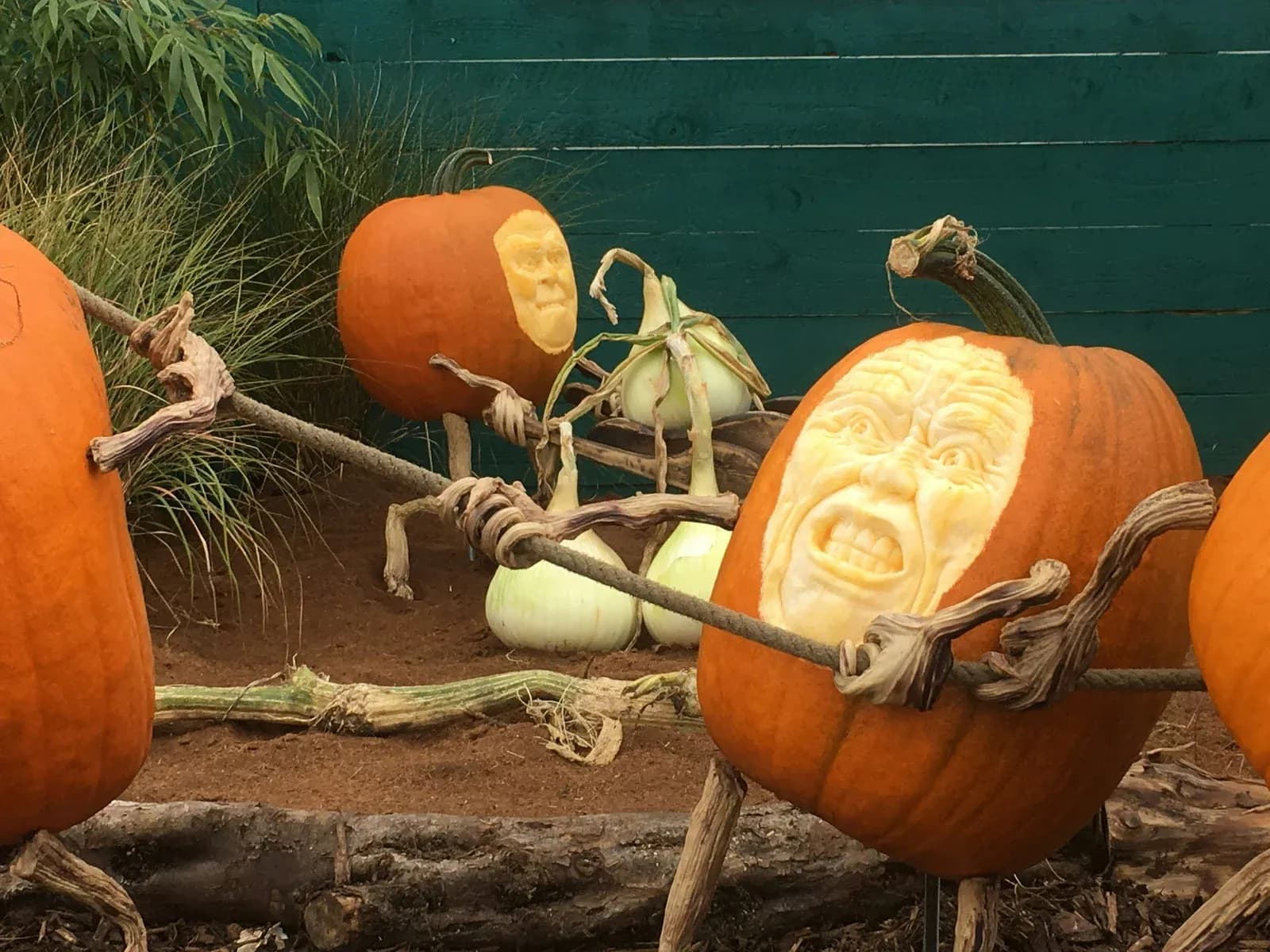
Photo: Paula Leach / Unsplash
On the weekend of 17th and 18th October, a man in orange overalls and a straw hat climbed onto a small stage on Main Street in Half Moon Bay, California, and began cutting into a pumpkin that, by the festival's own figures, could weigh anything from 300 to 1,500 pounds. The 54th Half Moon Bay Art and Pumpkin Festival billed it as his 40th year. Mike Valladao, known to the town as Farmer Mike, first stood on that stage in October 1986, and the San Francisco Examiner called him the Pumpkin Picasso in 1997. The festival has used a version of the title ever since. The 40-year count includes 2020 and 2021, when the festival did not take place, but nobody in Half Moon Bay seems inclined to argue.
The name has not stayed on the California coast. In October 2011 The Wall Street Journal ran a profile of Ray Villafane, a former art teacher from Michigan, calling him the Picasso of Pumpkin Carving, and his publisher has printed the phrase on his book jacket since. In Galva, Illinois, a travelling performer named Scott Norman, who bills himself as Stormin' Norman, adopted the same title without waiting for a newspaper to hand it to him. That gives one painter's name three owners, all of whom work in a material that collapses within days.
An engineer who carves on his holidays
Valladao's family came to the coast from the Azores about 150 years ago and opened the area's first feed store, and his grandmother taught in a one-room schoolhouse just south of town. He trained as an engineer, works in software, and for years has taken about six weeks off each autumn to carve.
His route into the craft began with one record-breaking vegetable. In 1984 he saw a 612-pound Atlantic Giant pumpkin at the Half Moon Bay festival, at the time the heaviest ever grown. He and his cousin Jerry decided to grow their own, and in their first season they produced pumpkins that outweighed him. Having no other use for them, he carved them.
In 1986 he took a pumpkin he had grown himself, its shell almost five inches thick, onto the festival stage and carved a laughing face in three dimensions, where the crowd expected triangle eyes. He had never carved in public before. Local television news picked up the story, and the attention eventually took him to The Tonight Show, where he carved Jay Leno's face into a pumpkin.
He calls his method 'pumpkin carving in the round'. The wall of a giant pumpkin can run six to eight inches deep, and Valladao works into that flesh the way a sculptor works into stone, building cheeks, brows and teeth in relief instead of cutting holes through to the hollow. He began with a buck knife and chisels. A single piece can take him up to four hours, and at the festival he usually finishes two a day while chatting to whoever stops to watch. To learn how to carve convincing teeth he spent long sessions smiling at himself in a mirror, and he changed approach once he noticed the pumpkins had started to look like him.
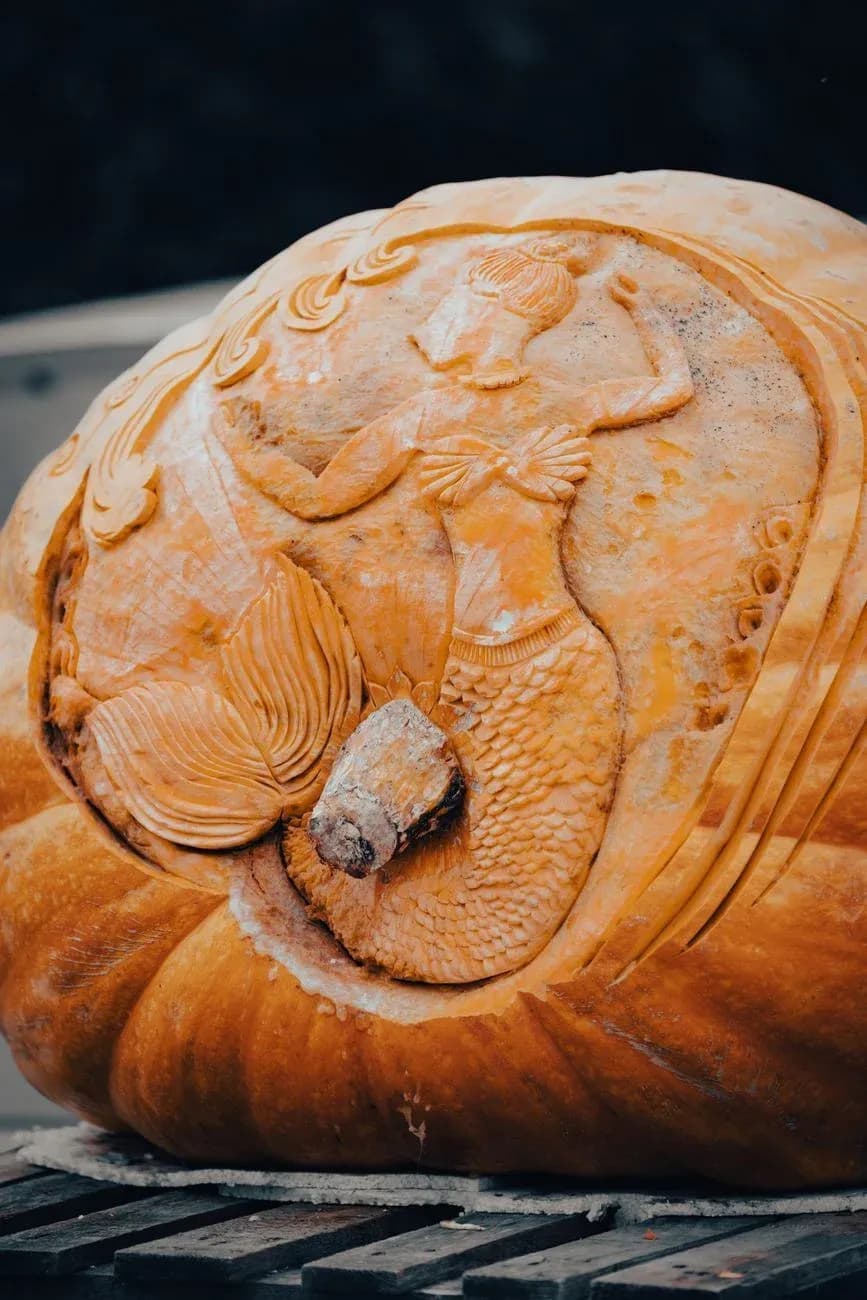
Most of his faces are cheerful, because he prefers the friendlier side of Halloween, but he lets the shape of each pumpkin decide the expression. 'If the pumpkin looks awkward and grumpy, so will the resulting sculpture,' he has said. His subjects over the years have ranged from Charlie Brown and Yoda to a Wells Fargo stagecoach, and one bearded old man with ringlets came from an artwork he saw in a German cathedral. In 2008 he published a children's book, Farmer Mike Grows Giant Pumpkins, and he has carved at the State Fair of Texas, the San Diego Zoo and the California Academy of Sciences.
The art teacher The Wall Street Journal crowned
Villafane was born in Queens, grew up on Long Island and graduated from the School of Visual Arts in New York in 1991. He then spent more than a decade teaching art to pupils of every age at the school in Bellaire, a small town in northern Michigan. One autumn a student brought a large home-grown pumpkin into class and asked him to carve it. He decided to treat it as a lump of clay instead of a vegetable, the children loved the result, and pumpkins kept arriving, first from pupils and then from their parents.
While still teaching, he began sculpting wax prototypes of action figures for Marvel, including Magneto and The Punisher, and in 2006 he left the classroom for a full-time job at DC Comics. In 2007 Food Network invited him onto a competition called Outrageous Pumpkins. He won all three rounds against three other professional carvers and came back in 2009 to defend the title.
The Wall Street Journal profile, written by Ellen Gamerman, appeared on 22nd October 2011, in the busiest autumn of his career. That month he carved what was then the world's heaviest pumpkin, a specimen of more than 1,800 pounds, into a zombie scene at the New York Botanical Garden. He also competed in the first series of Halloween Wars and carved for Heidi Klum's Halloween party in Las Vegas. Martha Stewart, who had him on her programme the same year, chose a different painter and called him the Michelangelo of pumpkin carving. There is an argument that hers is the more accurate comparison, since Villafane's work is sculpture in the classical sense: faces modelled in deep relief, often from photographs, with the eye sockets and the area under the nose cut deepest.
His pumpkins lean towards horror, from ghouls and zombies to faces apparently being devoured by smaller pumpkins. He has carved at the White House, now runs Villafane Studios in Arizona with a team of sculptors, builds sand sculptures in summer, and has returned to Food Network as a judge. He is also allergic to pumpkins. 'If I'm carving too many or too long, my skin gets really itchy,' he once explained.
The showman who named himself
Scott Norman of Galva, Illinois, takes a looser approach. He tours supermarkets, libraries and sports venues each autumn with an act that mixes carving with stand-up comedy, often with his wife and daughters carving alongside him. He appeared on America's Got Talent in 2012, wrote a book called Pumpkins: A Well Rounded View of the Well Rounded Food, and describes himself as a professor of pumpkinology as well as the Picasso of pumpkin carving. His advice to beginners is modest: a pumpkin about the size of a volleyball, a small stainless steel steak knife, and a tolerance for failure. 'My first year, we had a lot of pumpkin pie,' he told an audience in Sterling, Illinois.
Valladao has the earlier claim, Villafane the wider fame
On dates, Valladao wins. The Examiner used the name 14 years before the Journal did, and he has carved under it on the same street for four decades. On reach, Villafane wins: his book, his studio and his television work have carried the phrase to audiences who have never heard of Half Moon Bay. Norman's claim rests on his own say-so, which he admits cheerfully.
The comparison suits Valladao in one specific way. Picasso spent much of his career letting found objects suggest the image, and in 1942 he joined a bicycle saddle to a pair of handlebars and produced a bull's head. Valladao's rule that a grumpy-looking pumpkin makes a grumpy face is the same instinct, applied to a fruit that can weigh several hundred pounds.
The craft began with turnips in Ireland and Scotland
None of these men works in a tradition that began in America. In the 19th century, people in Ireland, Scotland, Wales and parts of England hollowed out turnips and mangel-wurzels at Halloween, carved grotesque faces into them and set a light inside. In Somerset the custom became known as Punkie Night. Irish folklore tied the lanterns to Stingy Jack, a drunkard who tricked the Devil, was turned away from both Heaven and Hell, and was left to wander the earth with a burning coal inside a hollowed turnip. The National Museum of Ireland's Country Life museum near Castlebar keeps a plaster cast of an early 20th-century 'ghost turnip', with jagged teeth and slit eyes. Irish and Scottish emigrants carried the custom across the Atlantic, where the native pumpkin was larger, softer and far easier to carve.
The turnip lantern had one job, which was to let light out into the dark. Valladao and Villafane do most of their work in the wall of the pumpkin rather than through it, so their best pieces are made to be seen in daylight, and they last only a few days before the flesh softens and sinks. Valladao has said the short life does not trouble him. If a carving gives the crowd 'a little bit of a happiness', he told a local television crew, the hours on stage are worth it.
Enjoying this article?
Subscribe to our newsletter and never miss a story. No spam, ever.

Editor-in-Chief
Editor-in-Chief of Rich Woman Magazine, founder of Sovereign Magazine, author of many books, Dr Marina Nani is a social edification scientist coining a new industry, Social Edification. Passionately advocating to celebrate your human potential, she is well known for her trademark "Be Seen- Be Heard- Be You" running red carpet events and advanced courses like Blog Genius®, Book Genius®, Podcast Genius®, the cornerstones of her teaching. The constant practitioner of good news, she founded MAKE THE NEWS ( MTN) with the aim to diagnose and close the achievement gap globally. Founder of many publications, British Brands with global reach Marina believes that there is a genius ( Stardust) in each individual, regardless of past and present circumstances. "Not recognising your talent leaves society at loss. Sharing the good news makes a significant difference in your perception about yourself, your industry and your community."
Related Articles

8 Mistakes That Ruin Spring Bulbs, and How to Plant Yours Right This Week

Gardening This Autumn: Low Maintenance Perennials

Buyers Priced Out of Big Cities Are Finding Cheaper New Homes in the South