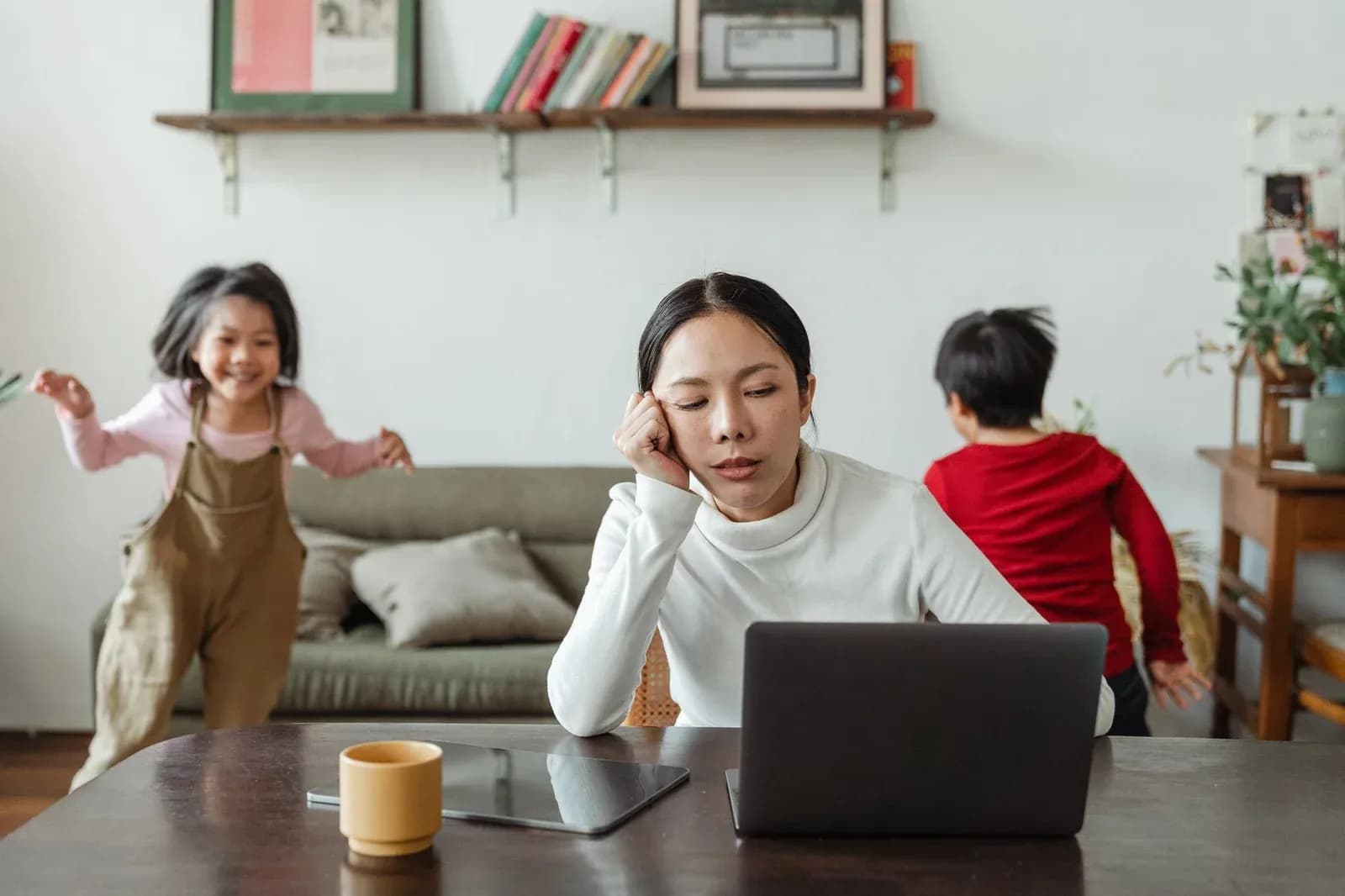
A Mother's Wellbeing Shapes Her Child's Mind, and Not Feeling Low Is Not the Same as Feeling Well
A Singapore study of 328 mothers and their four-year-olds found that a mother's positive wellbeing, not only the absence of depression, goes with warm, authoritative parenting and stronger thinking skills in her child.

Photo: Kamaji Ogino / Pexels
Rich Mom's November edition, Always Loving You, describes mothers who love without limits, even when they cannot love themselves. A study from Singapore suggests that the second half of that sentence matters for children too.
Researchers from the A*STAR Institute for Human Development and Potential, the NUS Yong Loo Lin School of Medicine and KK Women's and Children's Hospital studied 328 mothers and their children through GUSTO (Growing Up in Singapore Towards healthy Outcomes), a long-running birth cohort. When the children were between four and four and a half, they took standardised tests of IQ, vocabulary, numeracy and executive function, the set of skills children use to plan, focus and control impulses. The findings were published in JAACAP Open and highlighted by the researchers in March 2026.
Not being depressed is not the same as feeling well
Mental health screening usually places a mother on a single scale that runs from depressed to not depressed. The Singapore team measured two things separately: symptoms of depression and anxiety, and positive wellbeing. They found that the two work largely independently of each other, so treating depression does not by itself raise a mother's positive wellbeing.
Distress and wellbeing lead to different kinds of parenting
Mothers with more symptoms of depression or anxiety were more likely to parent in one of two ways: strict and punishing, or lenient with few boundaries. Both styles were linked to more behavioural difficulties in their children.
Mothers with higher positive wellbeing were more likely to parent warmly while setting clear boundaries and explaining their rules. That style was linked to stronger IQ, vocabulary, numeracy and executive function in their four-year-olds.
The researchers describe a third group that many women will recognise: the mother who is functional but not flourishing. She scores low on distress and also low on wellbeing. Her children may escape the harm that distress can do, but they may also miss the developmental benefits that a mother's high wellbeing brings.
The researchers' summary does not report effect sizes, so it does not show how large the differences between children were.
What authoritative parenting looks like at home
Psychologists sort parenting into three main styles, and the study points to one of them as the link between a mother's wellbeing and her child's development.
- Authoritarian parents are low on warmth and high on control. They expect obedience and punish without explaining why.
- Permissive parents are warm but set few standards and rarely enforce boundaries.
- Authoritative parents combine warmth with clear standards. They set limits and explain the reasons behind them.
The American Psychological Association describes authoritative parents as nurturing, responsive and supportive, yet firm about limits. In practice that might sound like 'Screens go off at six, because that is when we eat together and talk', said calmly and kept to, rather than a shouted 'Because I said so' or a shrug when the rule slips.
Associate Professor Helen Chen, a co-author and senior consultant in psychological medicine at KK Women's and Children's Hospital, noted that some Asian mothers grew up in families where an authoritarian style was common, which can make it hard to become warmer without becoming permissive. She described the study as evidence that clinicians can share with mothers to encourage a more authoritative approach.
Looking after yourself is part of looking after them
The study's first author, Dr Michelle Kee, a principal scientist at A*STAR IHDP, put the practical message simply: 'Helping mothers feel calm and confident may benefit both parenting and children's cognitive development during the preschool years.' She also suggested that public health policies could go beyond treating mental disorders.
For an individual mother, the study offers a reason to treat her own rest, friendships and sense of calm as part of her children's care rather than a reward for after it. Our guide to recovering from year-end parenting burnout and our report on talk therapy for depression in pregnancy cover two sides of that.
If you have symptoms of depression or anxiety, speak to your GP or health visitor. Feeling well is a separate goal, and the Singapore findings suggest it is worth pursuing for your own sake and for your children's.
In case you were wondering
What is authoritative parenting in simple terms?
What are examples of authoritative parenting?
What is the healthiest parenting style?
Enjoying this article?
Subscribe to our newsletter and never miss a story. No spam, ever.

Editor-in-Chief
Editor-in-Chief of Rich Woman Magazine, founder of Sovereign Magazine, author of many books, Dr Marina Nani is a social edification scientist coining a new industry, Social Edification. Passionately advocating to celebrate your human potential, she is well known for her trademark "Be Seen- Be Heard- Be You" running red carpet events and advanced courses like Blog Genius®, Book Genius®, Podcast Genius®, the cornerstones of her teaching. The constant practitioner of good news, she founded MAKE THE NEWS ( MTN) with the aim to diagnose and close the achievement gap globally. Founder of many publications, British Brands with global reach Marina believes that there is a genius ( Stardust) in each individual, regardless of past and present circumstances. "Not recognising your talent leaves society at loss. Sharing the good news makes a significant difference in your perception about yourself, your industry and your community."
Related Articles
More Than Half of Parents Say Their Child Avoids Creative Activities for Fear of Getting It Wrong

Dog Mums Are Mothers Too: Nine in 10 Owners Treat Their Dog as Family, and Brain Scans Help Explain Why
Children Do Not Laugh 300 Times a Day, but Mothers Laugh Almost Twice as Often as Their Toddlers During Play