
SurnaCare Launches a Fourth Trimester AI Companion Designed to Stop Short of Clinical Advice
Hellen S. Momoh started it as a Harvard deep learning class project, and classmates asked to invest before she had a company. The companion she built learns each mother's patterns and is designed to guide her toward human care when she needs it.

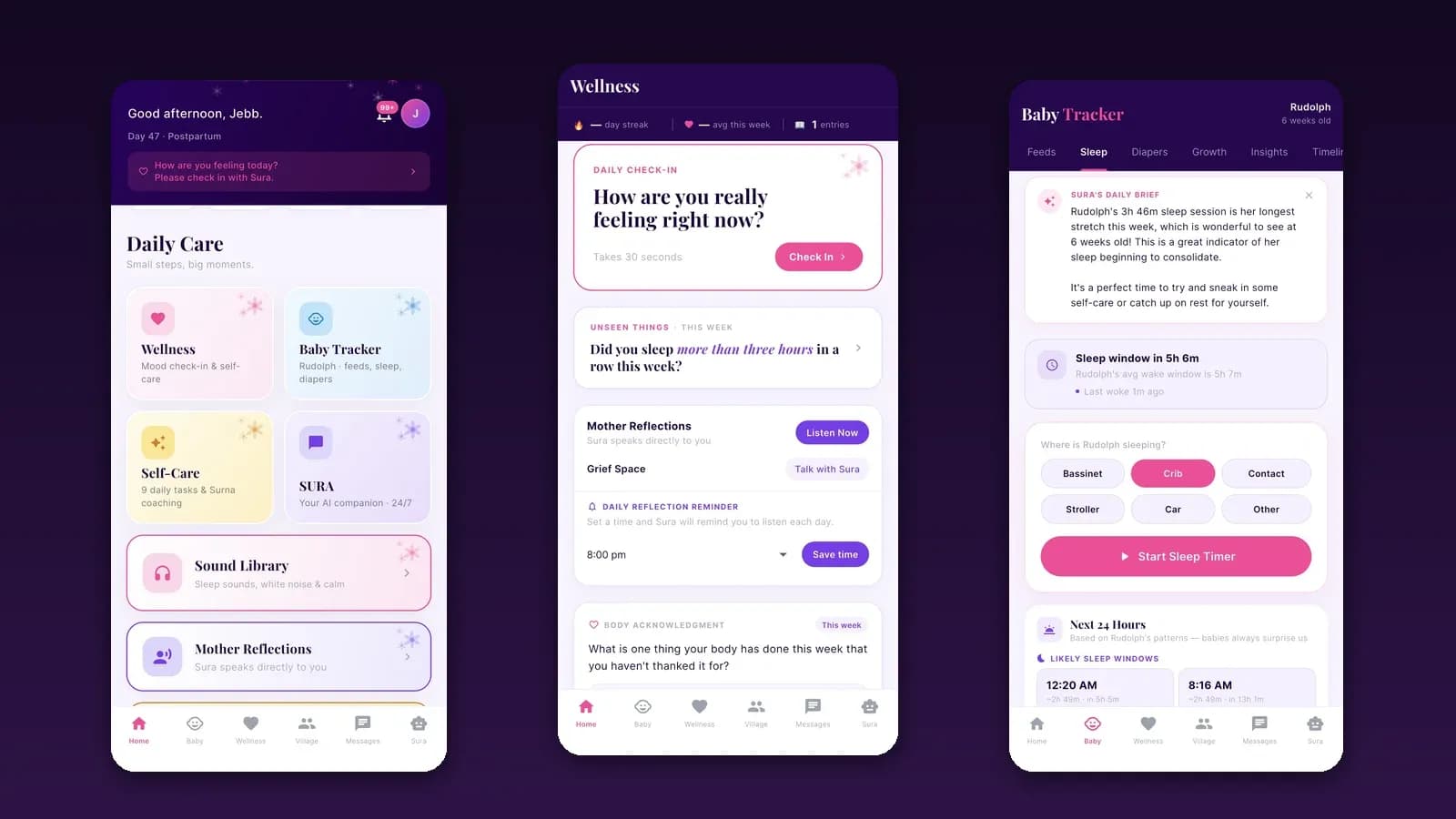
SurnaCare, a maternal wellness company headquartered in Cambridge, Massachusetts, has launched a postpartum platform built around SURA, an AI companion that supports mothers through the fourth trimester and the weeks after birth. SURA learns each mother's patterns from her mood check-ins, journal entries and her baby's routines, and responds to the whole picture of how she is doing rather than to each entry on its own. Founder and CEO Hellen S. Momoh designed it to guide a struggling mother toward human care rather than trying to provide that care itself.
"We have become very good at tracking the baby. But I kept coming back to the question: Who is tracking Mom? Caring for the baby should never mean losing sight of the mother," Momoh said.
The app went live on the App Store and Google Play in early August. It is free to download, with a SurnaCare Pro subscription at $9.99 a month.
The Harvard Class Project Behind SurnaCare
SurnaCare began as Momoh's final project in an Advanced Deep Learning class at Harvard University, where she graduated with a Master's degree in data science and artificial intelligence. She came to postpartum care from that direction, she says, struck by the gap between the volume of data new parents collect about a newborn, feeds, sleep, diapers, growth, and how little technology is designed to continuously understand the mother. So she designed the project the other way around: the mother at the center of the system, with the baby's activity as part of the context for understanding her experience.
When she presented the project in class, she recalls, classmates asked whether it was already commercial, whether she had a venture backer, and whether they could invest. She had not pitched it as a company at all. That reaction, she says, is what turned the class project into SurnaCare.
Momoh also founded Surna Technologies, a sovereign AI and digital infrastructure company focused on building locally controlled, institution-grade technology for frontier and emerging economies. The company develops AI-powered financial intelligence, regulatory analytics, secure data infrastructure, and sovereign cloud capabilities designed to help governments and public institutions modernize critical systems while maintaining control over their data and digital infrastructure. Its flagship MONARCH platform operates within the Central Bank of Liberia, supporting institutional intelligence and financial analytics, and Surna Technologies was named a finalist in the 2026 Harvard President's Innovation Challenge.
What the Postpartum App Includes
The platform combines a wellness check-in, a private AI journal, mother's health and reflection modules, a sound library, a 24/7 AI companion, a self-care program adjusted for birth type and recovery stage, a baby tracker, a peer community of mothers matched to the same postpartum day, and a module that gives the mother's partner daily guidance without sharing her private data, according to the company.
Throughout the platform, baby data is read as context for the mother, the premise carried over from the class project. If the baby has had several nights of disrupted sleep and the mother's check-ins and journal entries are trending down at the same time, the app is meant to recognize that those are one story.
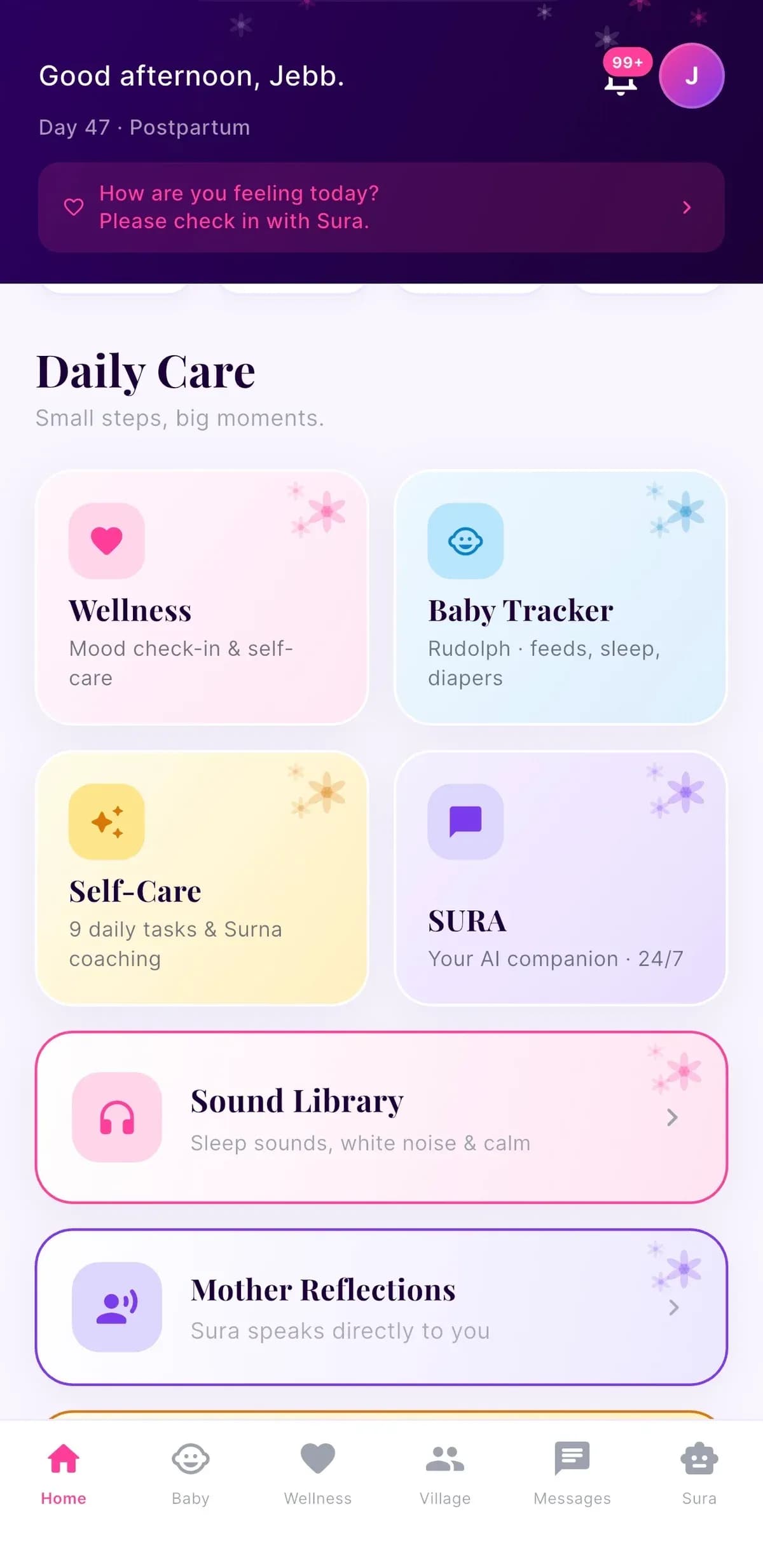
When a mother opens the app between 1am and 4am, it skips the logging prompts, tells her she does not have to be okay right now, and shows her how many other mothers are awake at that hour, a feature the company calls the 3am Protocol. Every Sunday the app writes her a personal letter drawn from what she logged and wrote that week. And once a week it asks: "Did anyone check on how you were doing this week, not the baby. You."
The Six Week Postpartum Checkup and the Twelve Week Window
American obstetrics formally moved away from the single six-week postpartum checkup in 2018, when the American College of Obstetricians and Gynecologists issued Committee Opinion 736, recommending contact with a provider within the first three weeks, ongoing care as needed, and a comprehensive visit no later than twelve weeks after birth. Postpartum care, the guidance says, should be an ongoing process rather than a single encounter. Practice has been slower to change, and for many mothers the six-week appointment is still the only scheduled contact.
About 1 in 8 women report symptoms of postpartum depression, according to the CDC. Mental health conditions are the leading underlying cause of pregnancy-related deaths in the United States, accounting for 27.7 percent of them, and CDC data show 47 percent of pregnancy-related deaths occur between one week and one year after delivery. SurnaCare's twelve weeks match the outer boundary ACOG set for comprehensive postpartum care.
Software as a Medical Device and the FDA Wellness Line
In its first version, SURA does not classify risk and does not decide when a mother should be referred to a doctor. "That is a deliberate choice, not a gap," Momoh says. The moment software starts making risk classifications and escalation decisions, it moves toward regulation as software as a medical device, with FDA implications, liability exposure and clinical governance requirements she says the first version is not structured to carry.
Momoh's rule for the first version is that SURA "surfaces, does not escalate."
If a mother's daily check-ins come in below 3 for five consecutive days, the app does not tell her to see a doctor. It tells her she has had a hard week, suggests that some of what she is carrying might be worth talking through with someone who can really help, and offers to share resources. That language is deliberate, Momoh says: it opens a door without pushing her through it.
The FDA's general wellness guidance, finalized in January 2026, draws the same line: low-risk wellness products stay outside device regulation only if they avoid diagnostic claims and outputs that guide clinical management. The agency convened an advisory committee in November 2025 specifically on generative AI mental health devices and has cleared no mental health tool built on generative AI to date. A handful of states, Illinois among them, now ban AI from delivering therapy outright.
The Edinburgh Postnatal Depression Scale and the Next Version
The second version, Momoh says, will add validated screening: the Edinburgh Postnatal Depression Scale, the instrument designed specifically for perinatal populations, alongside the PHQ-9, with an explicit composite threshold. Above it, the planned response tells the mother it is important she speak with someone today, not because something is wrong with her, but because she deserves more support than an app can give, followed by one specific resource. She is direct that screening with an explicit escalation threshold is different regulatory territory from the first version, and says the company plans to structure V2 to carry it.
"Surna is not a gatekeeper. She is a bridge," she says. The mother she describes is the one who has been struggling in silence for six weeks and never told her OB, because the appointment lasted fifteen minutes and the baby was the focus. The app's job is to get that mother to the clinician she would not have reached otherwise.
FAQ
Can AI chatbots help with depression?
Is there a mobile app that can help with postpartum depression?
Do I have to go to my 6-week postpartum checkup?
Is it safe to use AI chatbots?
Enjoying this article?
Subscribe to our newsletter and never miss a story. No spam, ever.

Editor-in-Chief
Editor-in-Chief of Rich Woman Magazine, founder of Sovereign Magazine, author of many books, Dr Marina Nani is a social edification scientist coining a new industry, Social Edification. Passionately advocating to celebrate your human potential, she is well known for her trademark "Be Seen- Be Heard- Be You" running red carpet events and advanced courses like Blog Genius®, Book Genius®, Podcast Genius®, the cornerstones of her teaching. The constant practitioner of good news, she founded MAKE THE NEWS ( MTN) with the aim to diagnose and close the achievement gap globally. Founder of many publications, British Brands with global reach Marina believes that there is a genius ( Stardust) in each individual, regardless of past and present circumstances. "Not recognising your talent leaves society at loss. Sharing the good news makes a significant difference in your perception about yourself, your industry and your community."
Related Articles

Q4 Burnout Parenting: Why Year-End Work and School Pressure Drain Working Parents, and Nine Ways to Recover
What Makes Younger Generations Choose a Childfree Life

International Day of the Girl: End child marriage and invest in girls' rights